Player development
Development you can show, not just describe
A player's development story should be built from what coaches actually observed across the season — captured as it happened, connected to the club's principles.
Capture
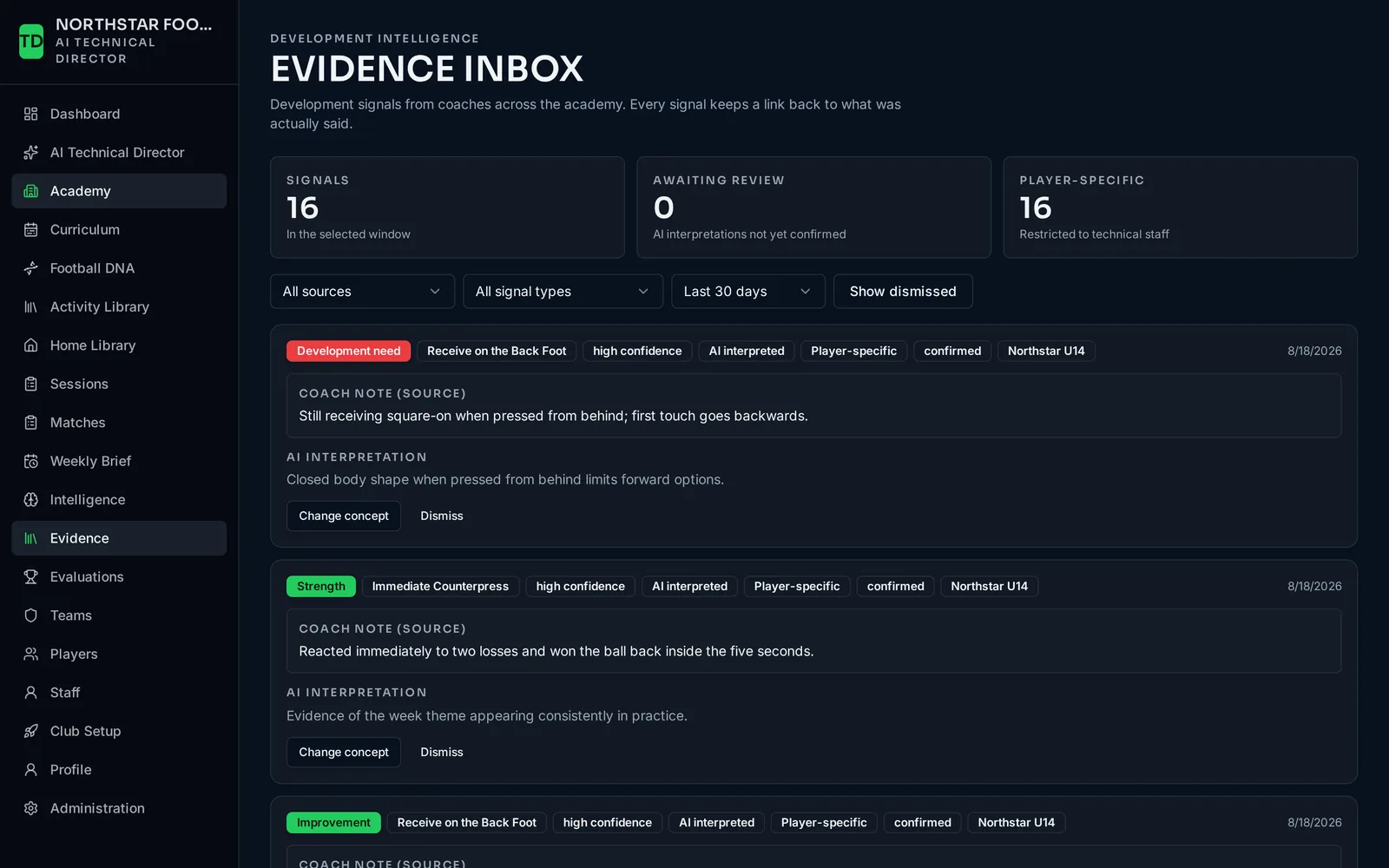
Evidence, captured in the moment
Coaches record what they see during training and matches, against the behaviours your methodology defines.
Practice Mode is built for the pitch: a phone in a coat pocket, a few taps between activities. An observation is tied to a player, a session or match, and the principle it relates to.
Because observations are structured rather than free-form notes, they can be read later by a different coach, in a different season, and still mean something.
Evaluate
Evaluations and player self-evaluation
Structured evaluation cycles that include the player's own view.
Consistent taxonomy
Every team evaluates against the same club framework, so comparison and progression mean something.
Player self-evaluation
Players assess themselves on the same framework, and the two views sit side by side.
Longitudinal profile
Evaluations build into a development profile that shows a player's trajectory across seasons, not just a snapshot.
Plan
Individual development plans that come from the evidence
Priorities and goals for each player, drafted from what has actually been observed.
Forma can draft an IDP for a player from their own evidence and evaluations: a small number of development priorities, each with goals a coach can work with. The coach reviews, adjusts and approves it — the plan only becomes real when a person says so.
Players see their own plan, can acknowledge it and add their own focus note. They cannot edit the coach-authored content, so the plan stays a coaching document while still belonging to the player.
Extend
At-home development that matches the plan
The work between sessions, pointed at the player's actual priorities.
Personalised assignments
At-home activities are selected against the player's development priorities and the club's curriculum, not generic drills.
Workload guardrails
Assignment volume is bounded, so extra work stays sustainable for a young player's week.
Mobile session guide
A simple guided view a player can follow on a phone in the garden or at the park.
Sustain
Engagement that rewards consistency
Development between sessions depends on a player actually showing up for it.
Streaks
Consistency over time is recognised, because habit is what produces improvement at this age.
Challenges
Structured challenges give a player something concrete to aim at between sessions.
Personal bests
Players track their own progress against themselves rather than against a leaderboard of teammates.
Talk it through
See it against your own club
If you want to see what a season of captured evidence looks like on a real player profile, we can show you. Book a demo and we will walk through it with your age groups, your methodology and your season in mind.